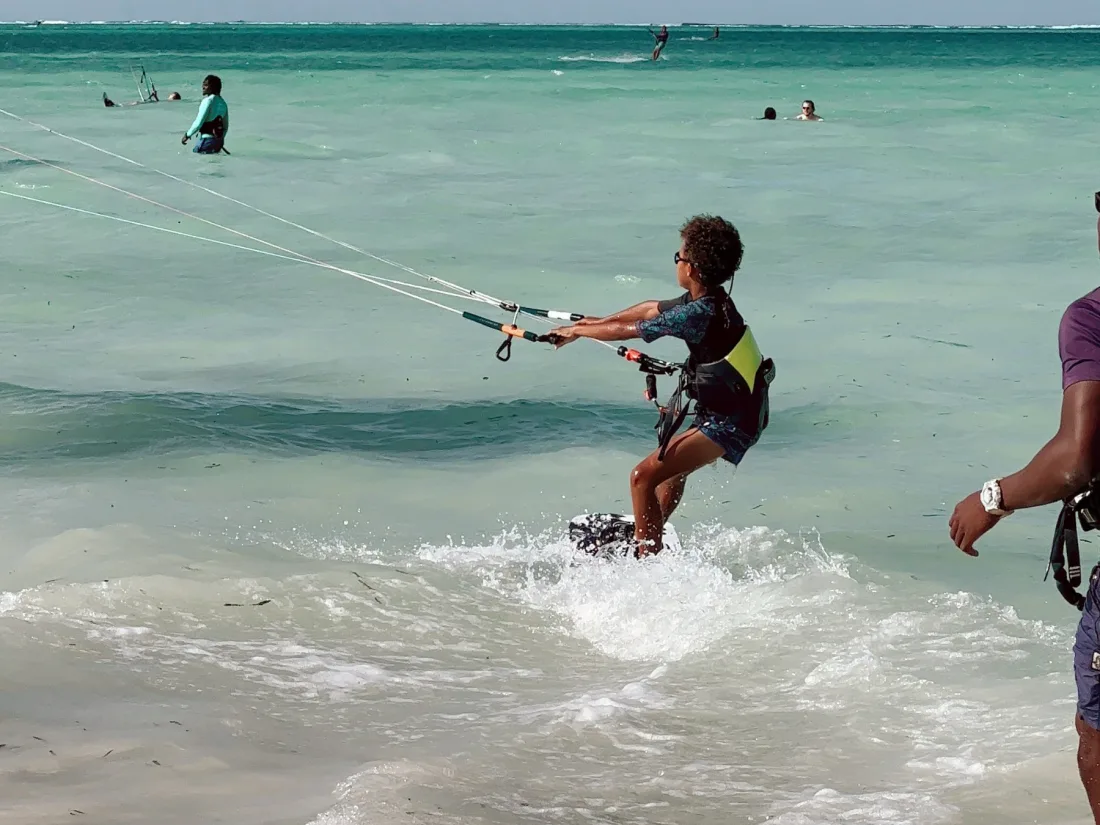
The kitesurf season in Paje runs almost all year: the south-easterly Kusi blows from April to October and is the stronger of the two winds, the north-easterly Kaskazi blows from November to March, and the light months are November and, above all, March. What a wind chart can't tell you is when the lagoon has water, so we laid our own tide table over the wind months. It changes which week you should book.
Everything about riding at the hotel itself, from levels to rooms, is on our kitesurf page. This one answers a single question: when should you come, and what will the water be doing when you get here?
Two winds, and which one blows harder
The coast of Tanzania lives on two monsoons. Three decades of station records show north-easterly winds prevailing from November to March and south-easterlies from April to October (Mahongo, Francis & Osima, 2011). Locally they are the Kaskazi and the Kusi, and they are not equal. NASA's climatology for Paje's coordinates gives these monthly mean wind speeds:
- June and July: the peak of the year, 13.9 and 14.1 knots.
- May, August and September: 12.9, 12.8 and 11.8 knots. May is already Kusi and its mean is high, but a monthly mean can't tell you how many days it blows.
- December to February: the Kaskazi, 9.6 to 11.3 knots, with January the strongest of the three.
- April, October and November: the hand-over months, 8.7 to 10.6 knots.
- March: 7.7 knots, the quietest month of the year. If wind is the whole point of the trip, this is the one to skip.
Read those numbers for what they are: 24-hour averages from a reanalysis model (NASA POWER, MERRA-2 monthly climatology) over a grid cell that mixes island and open sea, not afternoon readings on the beach. They are good for comparing one month with another, not for promising a number on a given day. The station records add the hour: along this coast, the wind generally peaks around 3 pm local time (Mahongo et al., 2011).
The tide sets the hours
Paje faces a reef lagoon that fills and empties twice a day, and the day follows the water: low water is for walking the flats, rising water is the kite window. Twice a month, around full and new moon, come the spring tides, when the daily range in our table is around 3.5 metres, against 1.4 at neaps. Both keep a timetable you can plan around:
- Spring tides: the daytime low lands between about 9 am and 1 pm, in every month of the year. The flats open across the middle of the day and the water comes back through the afternoon.
- Neap tides: the daytime lows fall early in the morning or from early afternoon on, never between 9 am and 1 pm. The lagoon keeps its water through the late morning.
Every day, hour and height is on our Paje tide times page, calibrated against the Zanzibar tide gauge.
Wind by the month, tide by the hour: what we found
We counted, month by month from November 2026 to October 2027, the days on which a deep low (1.5 metres or more below mean sea level) falls in daylight, between 6 am and 6:30 pm:
- Kaskazi, November to March: 11, 9, 11, 12 and 11 days. Almost every spring tide empties the lagoon in full daylight, and late February brings the lowest water of the season, about 2 metres below mean sea level.
- April: 10 days, the last month of the pattern.
- The heart of the Kusi, May to August: 2, 0, 2 and 5 days. The deepest lows move to the night, roughly between half past nine at night and half past one in the morning. By day, spring lows stay higher: about 1.4 metres below mean sea level in June and July, against 1.7 to 1.8 in December and January.
- September and October: 11 and 13 days, as the deep lows come back into daylight.
Put the two together and the year splits in two. From June to August, the strongest wind of the year meets a lagoon that drains less by day. From November to March, a lighter wind meets daytime flats as wide as any in the year, and on spring-tide days the session moves to the afternoon, behind the rising water, which is also when the wind is at its strongest. In between, September and October line the two up: 11.8 and 10.6 knots, with 11 and 13 days of deep lows in daylight.
Spring tides with a daytime low, this Kaskazi
From our table, the stretches when the low lands in daylight:
- 8–11 November 2026: lows from 9:34 to 11:08 am.
- 24–28 November: lows from 9:41 am to 12:35 pm.
- 24–28 December: lows from 10:21 am to 1:12 pm, Christmas week.
- 22–26 January 2027: lows from 10:20 am to 12:44 pm.
- 7–10 February: lows from 10:57 am to 12:11 pm.
- 20–25 February: lows from 10:05 am to 12:42 pm, the lowest water of the season.
- 9–12 March: lows from 10:51 am to 12:07 pm.
- 21–26 March: lows from 9:37 am to 12:09 pm.
Times are East Africa Time at the reef front; inside the lagoon the water takes a little longer to leave and to come back. The table is our own prediction from the EOT20 ocean tide model (Hart-Davis et al., 2021, CC BY 4.0), calibrated against the Zanzibar tide gauge, with a margin of ±15 minutes in nine tides out of ten.
How to choose your week
Spring tides come round twice a month, so a seven-day stay catches either the big tides or the small ones, rarely both at full strength. If you ride on your own and want the most wind, aim for June to August. If you are learning, the water matters as much as the wind: spring weeks put a long low across the middle of the day, and neap weeks keep water in the lagoon through the late morning. Tell us your dates and we'll check them against the table for you.
On the days the wind drops, the island is close: a morning among the red colobus of Jozani, or an afternoon in the lanes of Stone Town, an hour away by road.
Fill the no-wind days in your plan.
The forest, the old town, a spice farm — one request, one quote, nothing charged here.
From MONEA The Nest
The hotel has direct access to Paje beach and the lagoon starts at the garden gate, so you read the water over breakfast and decide the day from there. If you want the room and the wind week in one request, that is what Kite & Stay in Paje is for.
In short: the Kusi, from April to October, is the stronger wind, at its peak in June and July. The Kaskazi, from November to March, is lighter, and its spring tides put the lowest water in the middle of the day. March is the quiet month. Check your dates on the tide table before you book. See experiences and pricing →