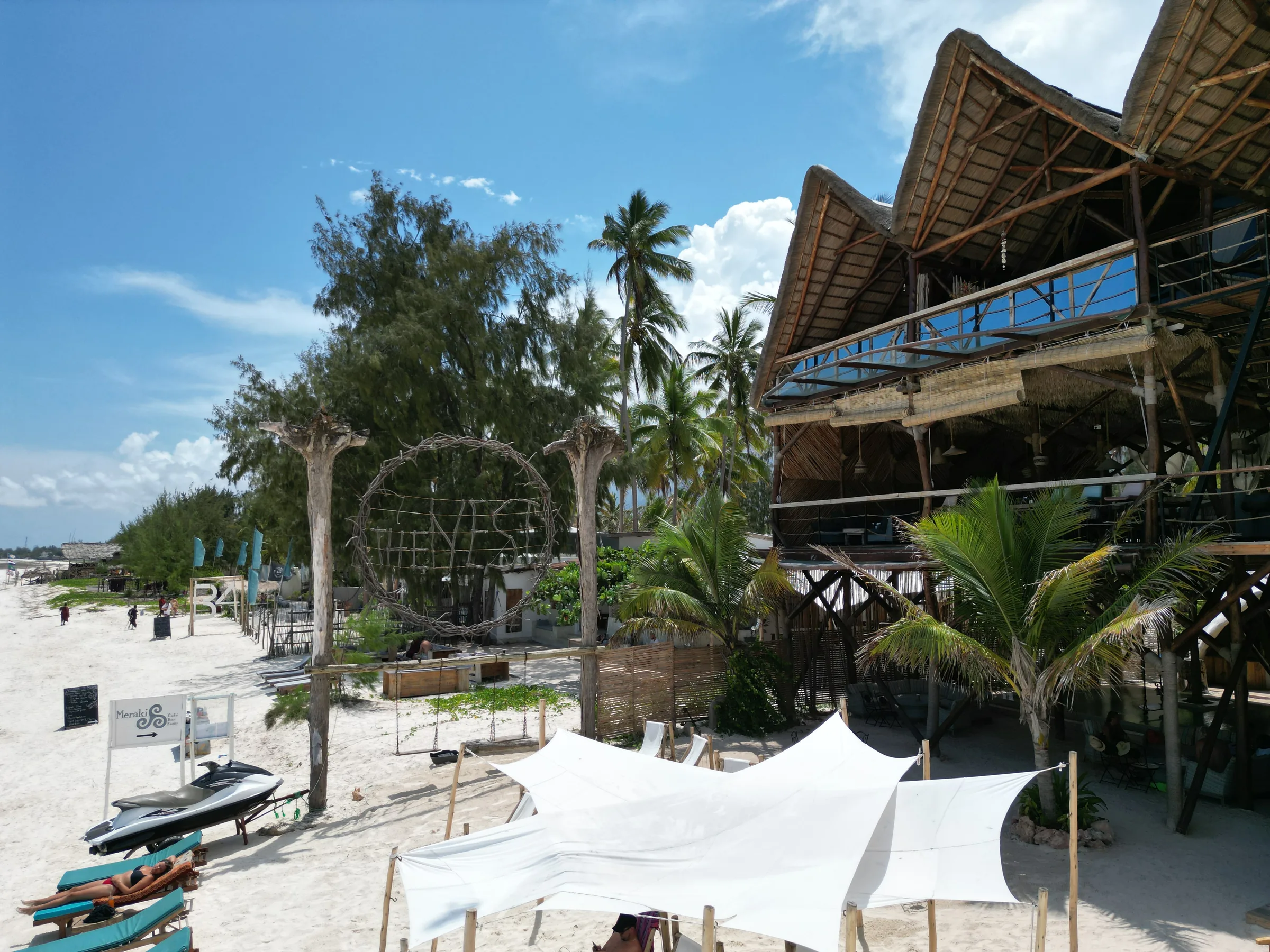
The best things to do in Paje, Zanzibar depend less on the day of the week than on the tide: walk the flats and the seaweed farms when the water is out, swim and kite as it comes back, and use the neap days, when the lagoon barely empties, for a trip inland. Our own tide predictions for Paje put the biggest low tides of every fortnight between about 9 am and 1 pm from November to January, so in those months a morning here often starts on foot, a long way out from the beach.
The Nest sits on Paje Beach Road with direct access to the sand, so everything below starts at the door of our tree houses and poolside villas. This is the list we would give a friend arriving tomorrow, in the order the water allows.
First, learn the tide
Paje faces a reef lagoon that fills and empties twice a day. It takes about six hours to go from high water to low, and each tide comes roughly fifty minutes later than the day before. Twice a month, around the new and the full moon, the spring tides pull the water much further out; in between, at the neaps, the lagoon barely empties.
It makes a real difference to a holiday. These are the spring-tide windows from our table for the coming season, with the low water landing in daylight:
- November 2026: the 8th to the 12th, with the low between 9:34 and 11:38 am, and the 23rd to the 28th, between 9:02 am and 12:35 pm.
- December 2026: the 9th to the 11th, between 10:27 and 11:28 am, and the 23rd to the 28th, from 9:36 am to 1:12 pm. Boxing Day has the lowest daytime low of these two months, at 11:48 am.
- January 2027: the 8th to the 12th, from 10:50 am to 12:39 pm, and the 22nd to the 27th, from 10:20 am to 1:18 pm, the deepest of the three months.
At the neaps it is a different lagoon. On 17 November, for example, the lows fall at 2:10 am and 3:06 pm and the water hardly leaves. The table is our own prediction from the EOT20 ocean tide model (Hart-Davis et al., 2021), calibrated against the Zanzibar tide gauge, in local time and for the reef front: allow 15 minutes either way, and a little longer inside the lagoon. You can check any date in our tide predictions for Paje.
When the water is out: walk the flats
At low water the lagoon turns into rippled sand and warm pools, and the village goes out to work on it. The seaweed farms are the reason: seaweed is tied by hand to lines staked over the flats that the low tide uncovers, and the work stops when the sea comes back (Positive News). Most of the farmers are women; across Zanzibar the crop involves some 15,000 to 20,000 people, about 90 percent of them women, and farmers interviewed in Paje, Jambiani and other villages report that warmer seas, stronger winds and irregular rain are cutting their yields (Springer).
- Go with the tide, not the clock. The water sits near its lowest for a couple of hours around the time in the table: go out in that window and start back as soon as it turns. The water returns across very flat sand, so it moves fast.
- Keep off the lines. The farms are someone's living. Walk between them, and ask before taking a picture of the people working.
- Look back at the beach. The fishing dhows come in during the morning with the catch, and from the flats you see the whole bay at once.
As the water comes back: swim and kite
Swimming at low tide is not really possible: the lagoon is ankle- to knee-deep. The postcard Paje, turquoise and deep enough to swim, returns with the rising water, and high tide is the time to be in it. Kiters follow the same clock and ride the rising and the high water. Which months blow, and how the wind lines up with these tides, is in our guide to when the wind blows in Paje; lessons, rental and the kite catamaran are on the kite lessons and rental page.
Put the right trip on the right tide.
Tell us your dates and we arrange each day around the water — one request, one quote, nothing charged here.
Between big tides: half a day inland or along the coast
A neap day, when the lagoon barely empties and the flats stay under water, is the time to leave the beach. Everything here is in our experiences catalogue; you request it, and we confirm.
- Kuza Cave, in Jambiani: a collapsed limestone cave with a pool inside, about eight minutes south by car (Showcaves). The easiest swim on a low-tide afternoon.
- Jozani: the island's only national park, home of the endemic, endangered red colobus (Tanzania Tourism). Our walk through Jozani forest explains what you will see.
- A spice farm: they are inland, not in Paje. A half-day spice farm visit pairs well with Jozani.
- Stone Town and Prison Island: half a day on the other side of the island, or a full day if you add a sandbank. Start with our Stone Town guide, and add the boat to the giant tortoises of Prison Island.
- Mnemba: the snorkelling island lies off the north-east coast, a long way from Paje; the trip takes half a day. Green turtles nest there from February to September (Wikipedia).
Dolphins at Kizimkazi: how to do it well
The dolphin boats leave from Kizimkazi, in the south. They are popular, and that has a cost: research off Kizimkazi found that the more boats there are, the more the mothers travel, which may leave them less time to nurse (Stensland & Berggren, 2007). If you go, choose a boat that does not chase them, lets you into the water well away from them and leaves it to the dolphins to come closer (Tanzania Tourism).
At the hotel, between tides
- The spa is open from 9 am to 6 pm; book treatments at reception.
- Yoga: there is no studio, but a visiting teacher runs group classes, cacao ceremonies and sound healing on request.
- Dinner: our restaurant, NEA, cooks Swahili and international food, always with a vegetarian option, until 10 pm. The details are on our restaurant page.
In the village
Paje is a village before it is a beach. Away from the hotels, cover shoulders and knees: the UK Foreign Office warns that women wearing shorts or sleeveless tops away from resorts may cause offence. During Ramadan, avoid eating or drinking in public outside hotels and restaurants (FCDO); in 2027 it is expected to begin around 7 or 8 February (Zakat Foundation). And the greeting you will hear all day is mambo; the answer is poa.
In short: check the tide first. Spring-tide mornings are for the flats and the seaweed farms, rising and high water for swimming and kite, and neap days for Kuza, Jozani, the spice farms or Stone Town. Tell us your dates and we'll lay each day over the tide — in the plan builder. See all experiences →